
The pressure to hire AI talent in 2025 has been intense.
Leadership wants AI skills yesterday for product differentiation and workforce efficiency, competitors are hiring aggressively too, and the salary expectations you're hearing for AI talent are all over the place.
It’s hard to see through the noise and figure out what's actually happening in the market.
Is demand for AI skills as explosive as it seems? And more importantly, what do you actually need to pay to compete?
We analysed Ravio's compensation database to answer exactly those questions. Here's what the data shows about AI hiring growth, salary premiums, how AI is reshaping the broader job market, and what this means for your compensation strategy.
How has demand for AI talent changed in 2025?
The biggest trend in hiring and compensation this year has to be AI talent becoming the new battleground for competitive advantage in tech.
In fact, analysis for our 2026 Compensation Trends report found that the proportion of new hires in AI/ML roles grew by 88% this year (compared to the previous 12 months).
"Every company is either hiring for AI talent or upskilling existing teams, but success depends on being intentional about it. Some clearly understand what AI capabilities they need; others are just reacting to FOMO. The companies that balance being lean with rewarding high-impact AI talent are the ones attracting both funding and the right people."

Early Stage People Lead at EQT Ventures
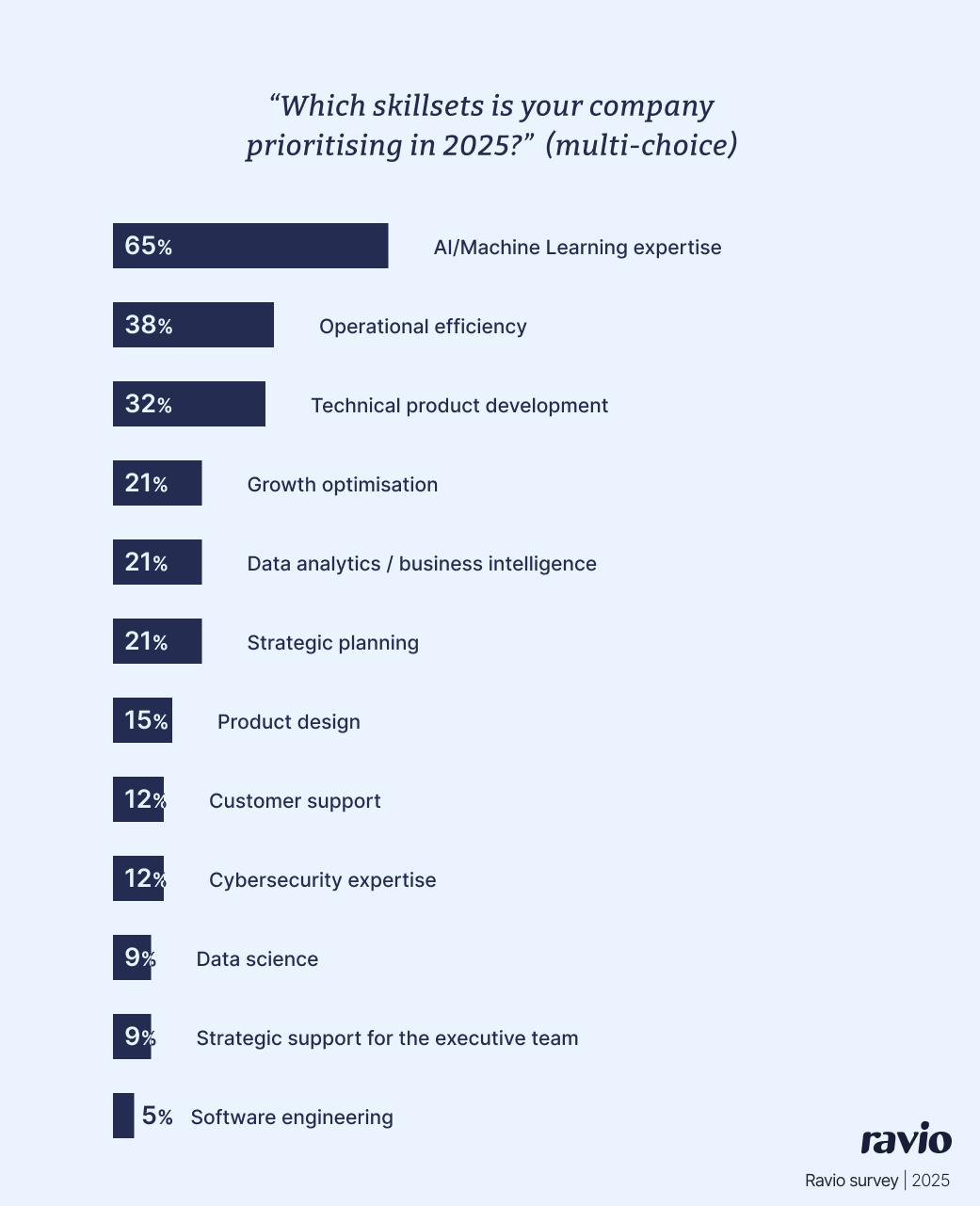
When we surveyed Reward leaders earlier this year about which skillsets their company was prioritising in 2025, AI and Machine Learning expertise topped the list by far, with 65% of companies making building AI skillsets a business priority.
Responses on why AI is such a priority highlight a need to keep up with competitors ("we need to embrace AI or be left behind"), optimise business processes ("to increase speed and efficiency, and reduce costs"), and differentiate products ("to accelerate AI transformation within our product").
In terms of which roles companies are bringing AI skills into, in the last 12 months the number of unique AI/ML job titles that companies are hiring for has increased by 50%.
These new AI job titles are appearing across all functions – as companies seek the AI skillsets to effectively embed AI tooling and automation to drive efficiency across company processes, reshaping how all teams work.
"Our portfolio companies are universally updating their hiring expectations to include AI know-how – not just in technical roles, but across all functions. We're even seeing hiring managers justify new headcount by demonstrating where AI tools fall short and why human expertise remains critical. The role evolution is fascinating: Customer Success roles evolving into AI Engineers, Digital Marketers becoming 'Vibe Marketers', and SDRs shifting into AI-Enabled or Prompt Engineering SDRs."

VP People at Earlybird
However, by far the most common function for AI/ML job titles is Software Engineering, with AI/ML Engineer representing 45% of all AI/ML job titles in Ravio's benchmarking database, and Senior AI/ML Engineer a further 15%.
AI/ML Researcher is another common job title, at 1.4%.
"AI has gone from a side project to the core of engineering teams. In our recent pulse survey, founders expect that 20-50% of their engineering org will be AI engineers within 12 months. These AI engineers are not just prompt-tuning -- they're owning model evaluation, LLM stack building, and collaborating across product and design. It's no surprise compensation for these roles is commanding higher premiums."

Talent and Portfolio Development Partner at Northzone
How is AI impacting employment trends across tech?
It's clear demand for AI talent is high – companies are prioritising bringing AI skills into the workforce across all functions.
But as AI is adopted to support more efficient processes, it's also impacting other areas of work, particularly administrative and entry-level roles.
AI use in the workforce is causing reduced demand for administrative roles
Analysis for Ravio's tech job market report found that hiring rates for administrative roles are down 32.5% in the past year globally.
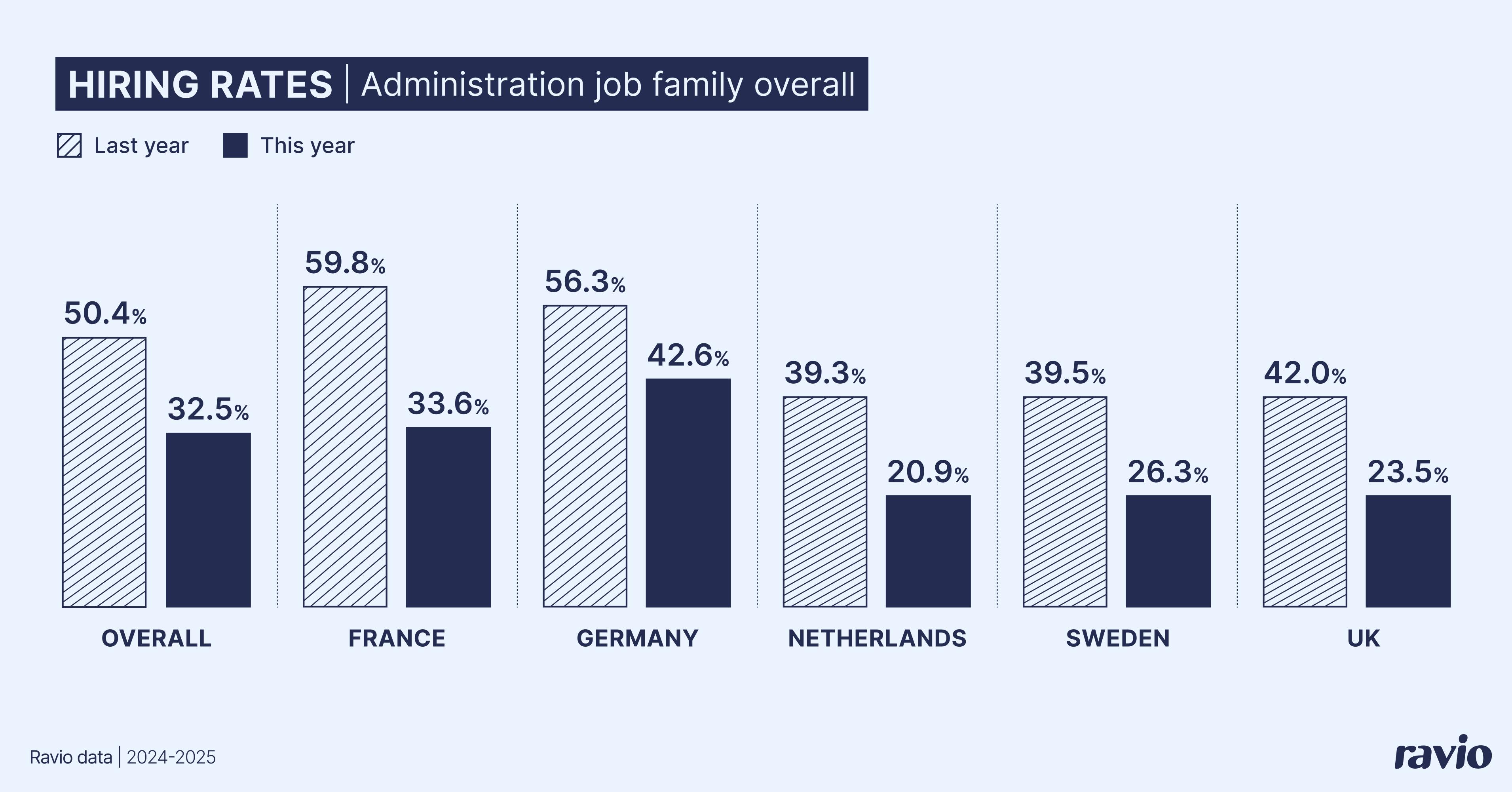
Administrative and support-focused roles typically contain a significant proportion of repetitive, routine tasks – which AI tools are able to automate, leading to a reduction in hiring.
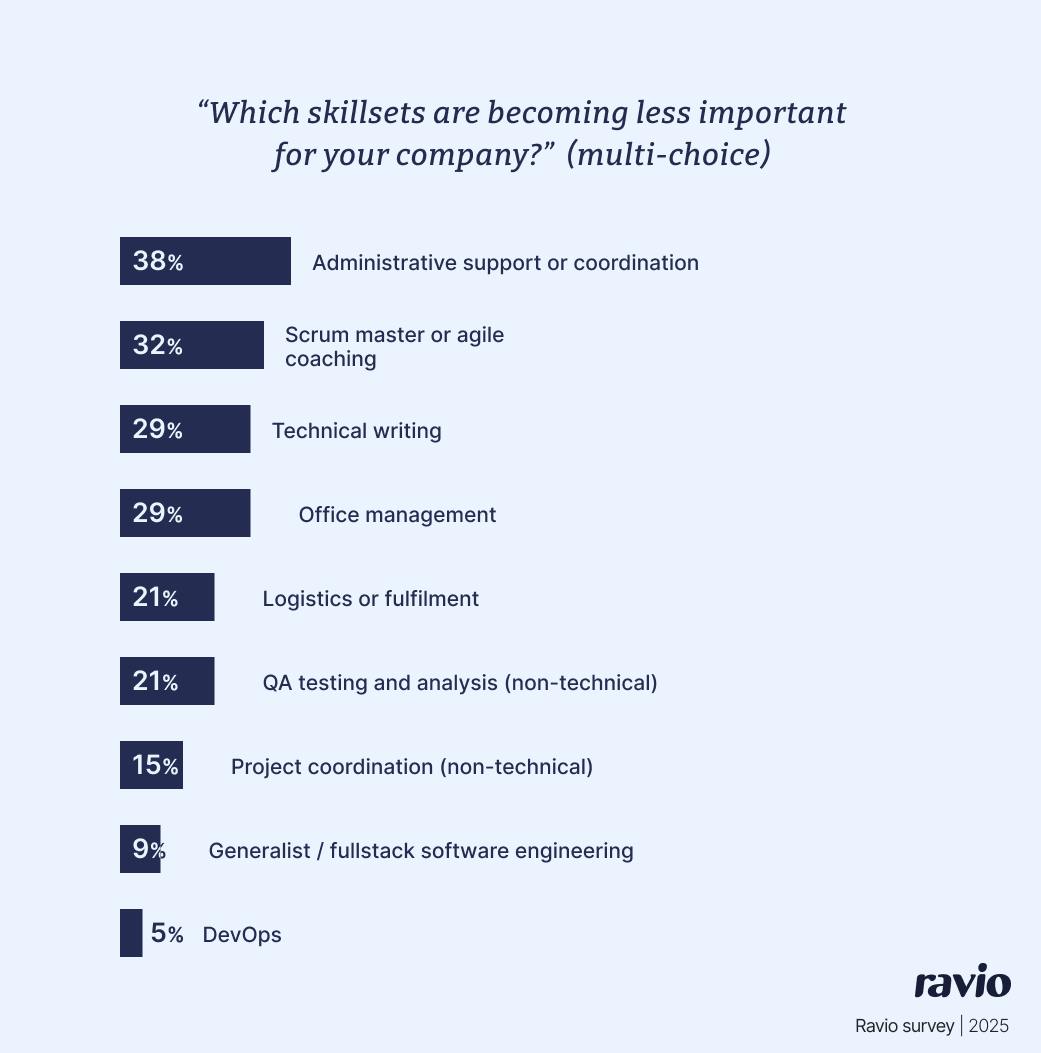
When we surveyed Reward leaders about which skills they're deprioritising for hiring in 2025, administrative and coordination-focused roles were bottom of the list.
50% of respondents explicitly cited AI automation as the reason, with responses like "they can be automated," "AI can substitute," and "we are going to automate processes and have less operative roles."
AI use in the workforce is causing reduced demand for entry-level talent
Entry-level roles have been hit even harder. P1 and P2 roles have seen an average decrease in hiring rates of 73.4% in the last year.
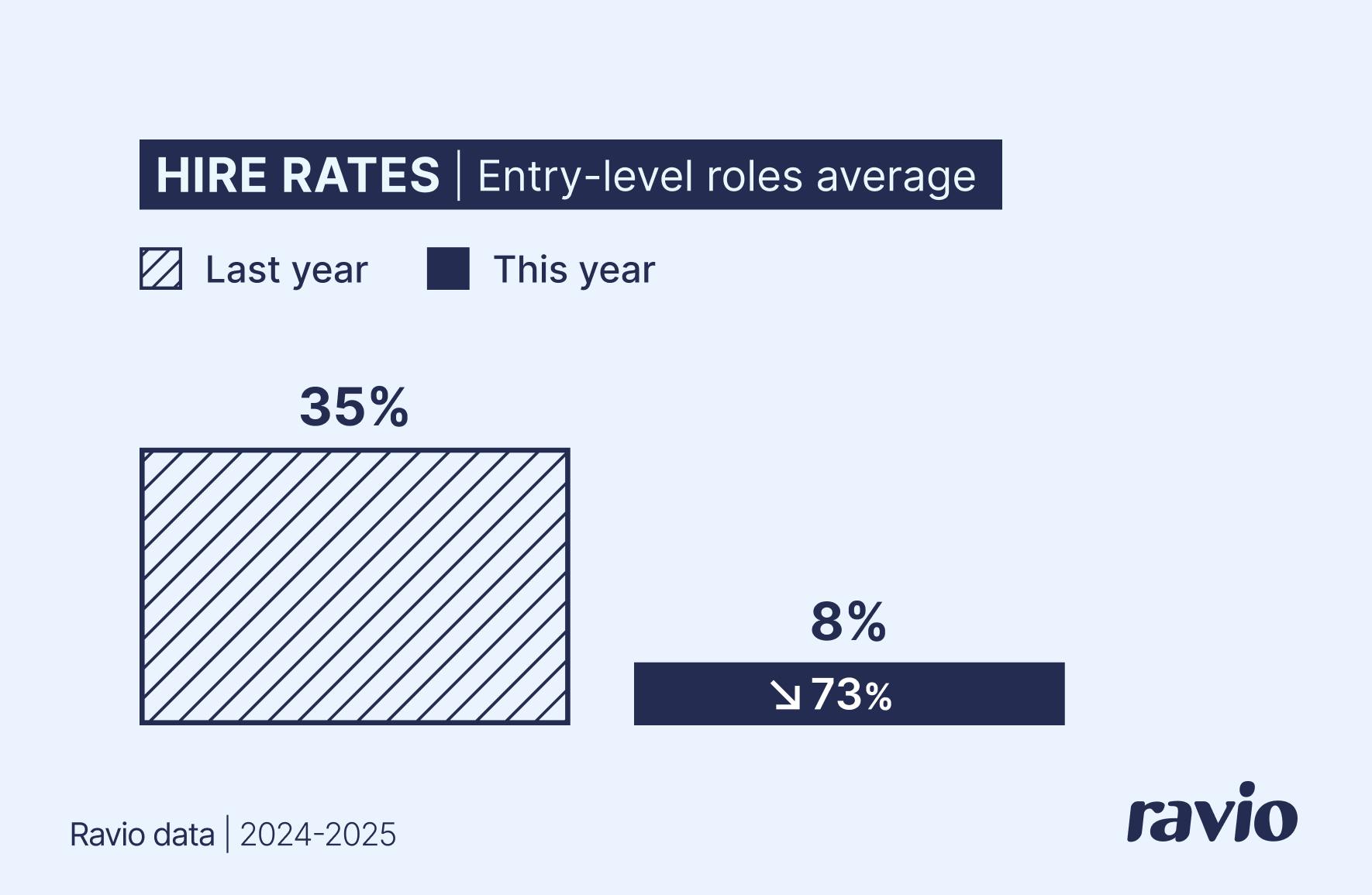
Junior roles in People, Marketing, Administration, Operations, and Engineering are particularly impacted – all having seen an even higher drop than this overall average.
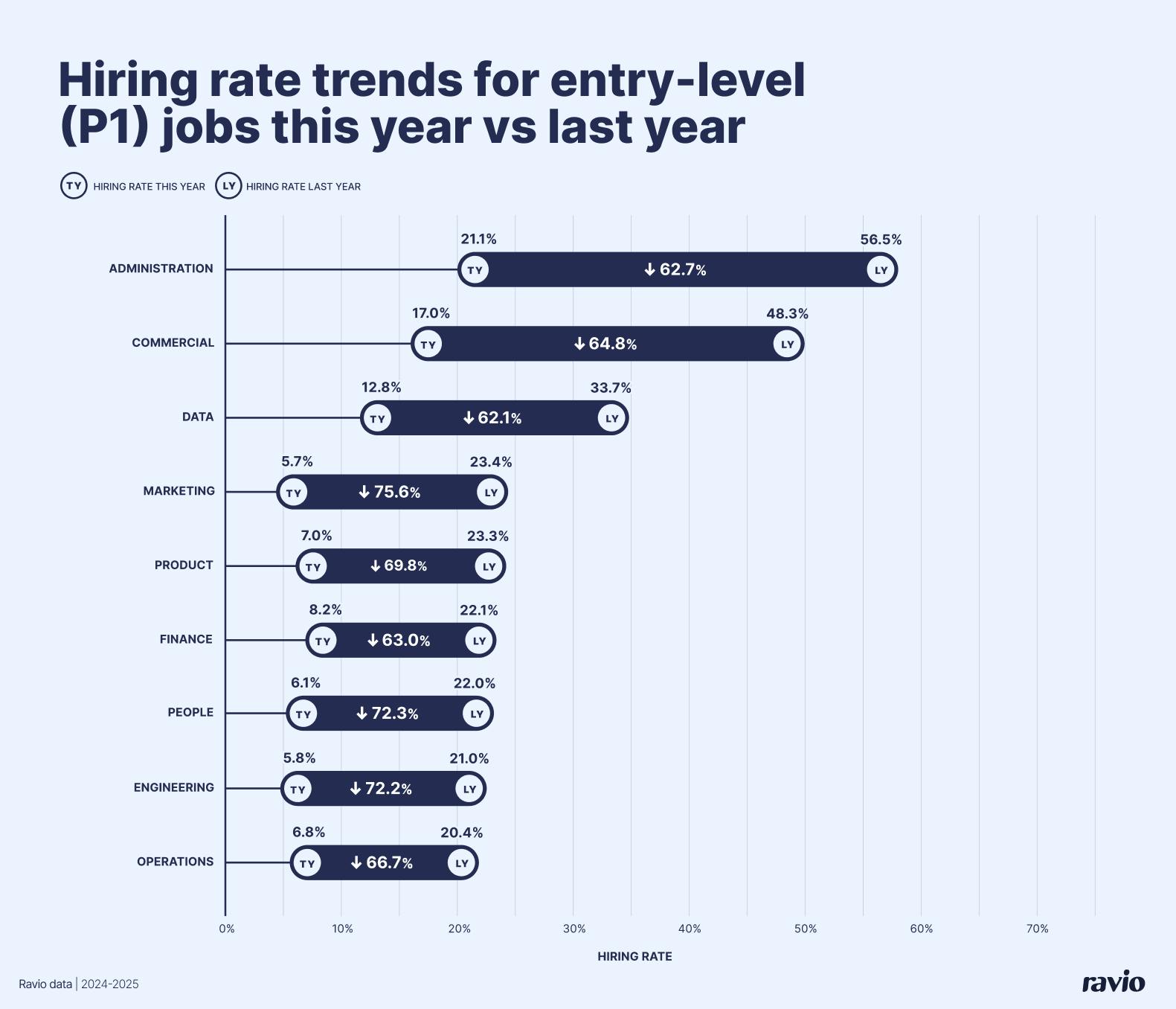
Entry-level roles have traditionally been a way for companies to bring fresh perspectives and develop junior team members into best-fit talent for mid-career roles. With this early career talent pipeline shifting, HR and business leaders may need to reconsider career pathways and succession planning.
How do AI salaries compare to non-AI salaries in 2025?
With AI skills in high demand, compensation for AI talent now commands a market premium across all levels.
Looking at Ravio’s data for the Engineering, IT, and Data job families (those with the vast majority of AI job titles currently), we can see that there is a:
- 12% salary premium for AI talent at Professional / IC job levels – a significant premium, but much lower than might be expected given the extreme examples that have hit headlines this year, like the multi-million dollar bonuses being offered by Meta for top AI Engineering talent.
- 3% salary premium for AI talent at Management level – there seems to be less competition for bringing AI into management roles compared to hands-on contributors who are integrating AI into workflows.
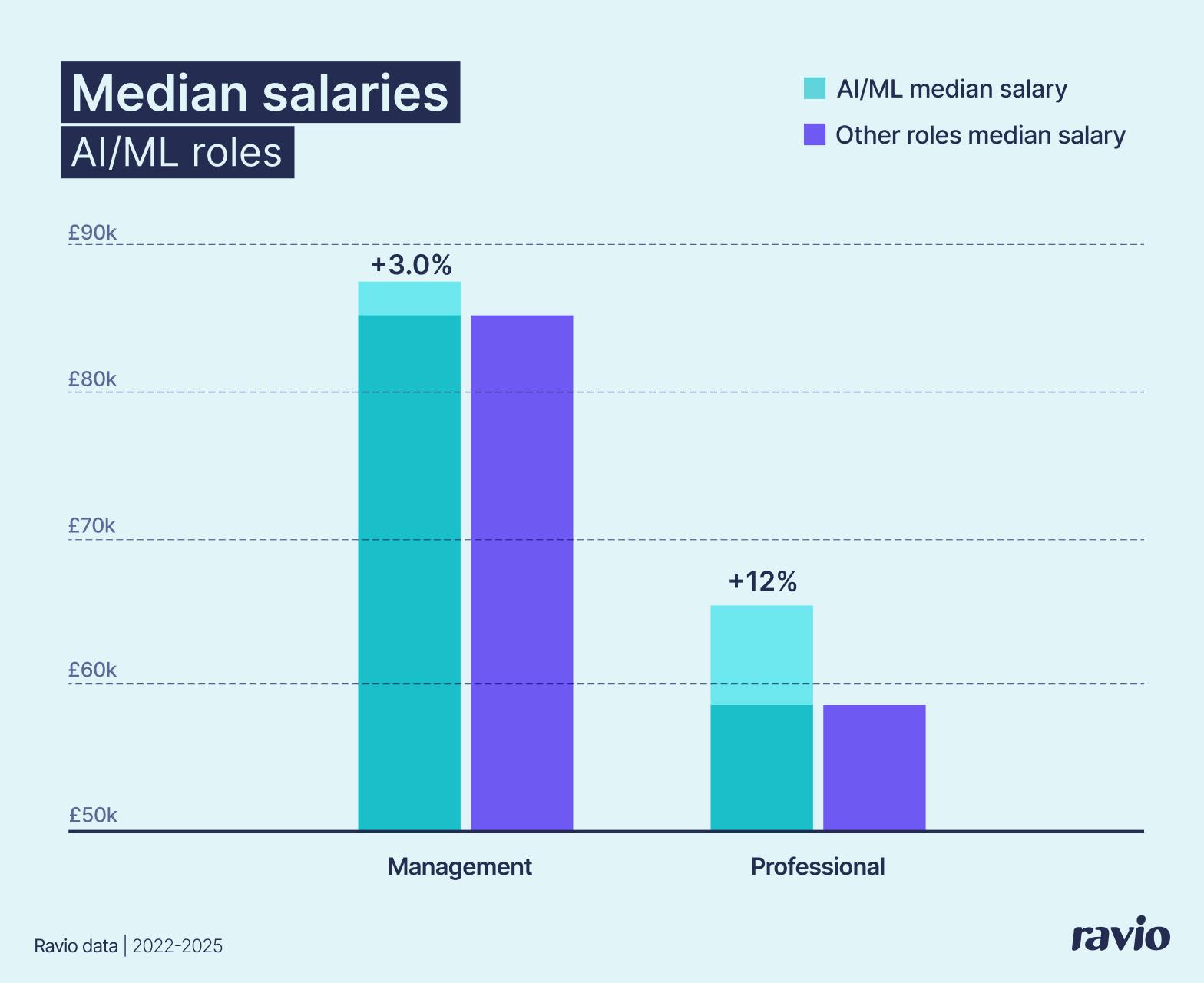
To put this into context, let’s take the example of an AI Engineer.
Ravio’s salary benchmarks show that the median (50th percentile) salary for a P3 Software Engineer in the UK is £70,000 (correct as of November 2025).
So, applying the average Professional-level pay premium, the median salary offer for a P3 AI Engineer in the UK is currently £78,400.
It’s a significant premium – but whilst extreme compensation packages are possible for the very top AI in big tech, the reality for the median tech worker is much less pronounced.
For example, if the typical salary for a P3 Software Engineer at the 50th percentile in the UK is £70,000 (Ravio benchmarks, November 2025), then a P3 AI Engineer at the 50th percentile in the UK earns £78,400.
What do these AI compensation trends mean for your pay strategy?
The combination of 88% hiring growth, 50% increase in unique AI job titles, salary premiums, and simultaneous displacement of other roles creates immediate challenges for compensation teams.
Here's how to navigate this strategically.
1. Don't abandon your compensation framework – but do apply flexibility
When the pressure is on to secure AI talent, there's a temptation to throw out salary bands and pay whatever it takes.
But those "exceptional" salaries set precedents you can't easily reverse.
"In my experience, with shifts in demand like we're seeing for AI, the market almost always spikes and then settles down – that market premium doesn't last forever, but the consequences of baking it into your payroll costs via a higher than desirable base salary do."

Senior Reward Consultant at Gallagher
Instead, consider ways that you could apply flexibility without breaking your structures – leveraging techniques such as time-limited adjustments with clear review cycles rather than permanent increases, or leveraging other elements of total compensation like enhanced equity or sign-on bonuses to secure AI talent.
"When you think about compensation for in-demand jobs, you instantly think of hiring external talent in a competitive market, but retaining existing talent who are seeing job adverts with salary ranges much higher than their own is equally (if not more) important."

Reward Consultant at Gallagher
If you do need to apply market premiums or other levers, document clear business justification for any departures from standard salary structures.
Read more: How to compete for in-demand jobs without breaking your compensation structure
2. Think strategically about where AI skills actually matter
Not all AI roles are equally critical to your business, and are therefore worth the premium compensation costs.
Consider which AI capabilities you genuinely need to meet business goals – both from a product (i.e. AI features) and workforce (i.e. AI tooling) perspective – and focus your premium compensation on the roles that will truly drive competitive advantage.
It’s also important to consider which AI skills you could support existing employees to develop over time, and which you need to hire-in immediately.
"Right now, we see eye-watering salaries for AI talent. The risk is overpaying for skills that may commoditise quickly. Companies need a clear workforce plan: which AI skills are truly differentiating and worth the premium, and where they can reskill existing talent."

Co-founder of Invested
3. Benchmark AI roles carefully when data is limited
When benchmarking emerging AI roles, relying on limited data points can lead to costly mistakes. Cross-check multiple data sources, especially real-time data from providers like Ravio, and look for patterns to make informed decisions about market positioning.
Read more: How to benchmark emerging or niche roles
"Over-relying on only a few isolated data points or anecdotal evidence from peers is a big risk when benchmarking niche or emerging roles and skills like AI in 2025."

Independent Total Rewards Consultant
4. Don't forget about your talent pipeline
While focusing on AI hiring, remember the impact on career progression and succession planning. Entry-level roles are down 73% – so how are you developing your future AI talent?
Consider evolving junior roles to include AI-native skills rather than cutting them entirely.
Read more: Early career hiring is down 73% – here's why it's time to redesign entry-level roles
"If you don't hire and nurture young talent now, what will your mid-level and leadership positions look like in five years?"

Global Talent Acquisition & Employer Branding Leader and Co-founder of Cohorts
FAQs
What is considered AI talent?
AI talent refers to professionals with skills in artificial intelligence and machine learning, including roles like AI Engineers, AI Researchers, Machine Learning Engineers, and AI-focused specialists across functions (such as AI Sales Prompt Engineers or AI Compliance Officers).
How will AI affect employment trends?
AI is creating demand for net new skills, while simultaneously reducing demand for routine administrative roles. Ravio's analysis shows AI/ML hiring grew 88% year-on-year in 2025 (Ravio 2026 Compensation Trends report), whilst administrative role hiring decreased 35.5% and entry-level (P1/P2) hiring dropped 73.4% (Ravio tech job market report). When surveyed, 50% of Reward leaders explicitly cited AI automation as the reason for deprioritising administrative roles.
How to recruit AI talent?
Recruiting AI talent requires a strategic approach that balances competitive compensation with clear workforce planning:
- Focus on identifying which AI capabilities are genuinely business-critical versus where you can upskill existing talent.
- Build flexibility into your compensation approach through market premiums with review cycles, enhanced equity packages, and retention bonuses rather than permanent base salary increases.
- Cross-check data sources when benchmarking compensation for AI roles and ensure the use of real-time data providers like Ravio, as over-relying on limited or outdated data points for these emerging roles can lead to costly mistakes.
Are machine learning engineers in demand?
Yes, machine learning engineers are among the most in-demand roles in 2025. Ravio's data shows AI/ML hiring grew 88% year-on-year, with AI/ML Engineer representing 45% of all AI/ML job titles.
Is AI engineering a high-paying job?
Yes, machine learning engineering commands a significant salary premium. Ravio's 2026 Compensation Trends report found that AI/ML roles command a 12% premium at the Professional (IC) level and a 3% premium at the Management level compared to non-AI roles. The smaller management premium suggests companies are prioritising hands-on contributors who are directly integrating AI into workflows.
Where can I get reliable salary benchmarking data for AI roles?
For emerging AI roles, look for real-time compensation providers that draw data directly from live HRIS and ATS integrations – ensuring market shifts and new roles are captured as they happen, rather than relying on annual salary surveys with 6-18 month old data.
Equally important is robust methodology: with emerging roles inevitably experiencing market volatility, you need benchmarks that are statistically validated with significant sample sizes and confidence levels.
Ravio provides real-time salary benchmarks with a specialisation in the tech industry, meaning it captures emerging AI roles and skillsets like AI Engineering as they develop. Ravio's compensation database covers 400,000+ employees across 1,500+ tech companies, with every benchmark verified by expert benchmarking specialists to ensure accuracy and reliability.